Crimson Desert is the kind of game that takes a long time to review honestly — not because it’s difficult to understand, but because it’s difficult to weigh. After more than 70 hours exploring the continent of Pywel, I still hadn’t exhausted its side quests, secrets, and activities. This is a game of extraordinary scale and genuine technical achievement. It is also a game that routinely trips over its own ambition.
Pearl Abyss, the studio behind the long-running MMO Black Desert, has brought that same content-maximalist philosophy into a single-player open-world action RPG — and the results are both spectacular and exhausting, sometimes within the same hour. What follows is the most honest accounting I can give of a game that deserves neither easy praise nor dismissal.
Crimson Desert Review (2026) Verdict
A technical marvel and genuinely ambitious open world that delivers on exploration and combat spectacle, but stumbles significantly on story, character development, early-game grind, and the sheer weight of its own systems. Best experienced by players who prioritise world exploration over narrative. Not the next Red Dead Redemption 2 — but something interesting in its own right.
7.2 out of 10
70+ Hours Reviewed
5 Distinct Biomes
2× Skyrim Claimed Map Size
₹4,499 Standard Edition (India, PC/PS5/Xbox)
Quick Verdict — Should You Buy Crimson Desert?
Buy It If You…
- Love enormous open worlds to get lost in for hundreds of hours
- Prioritise exploration, combat spectacle, and sandbox freedom over story
- Enjoy MMO-style content depth — crafting, fishing, base building, card games
- Want a technical showcase — the BlackSpace Engine is genuinely stunning
- Are OK with challenging, Soulslike boss fights
- Have a capable PC to run it at DLSS Quality + Frame Generation
Skip or Wait If You…
- Need a compelling narrative and memorable characters to stay invested
- Don’t have patience for early-game resource grinding
- Expect a medieval Red Dead Redemption 2 experience
- Are easily frustrated by clunky interaction mechanics and menu overload
- Have limited gaming time — this demands significant hours to open up
- Think ₹4,499 is too steep for a game with the listed shortcomings
The World of Pywel — Scale, Biomes and Exploration
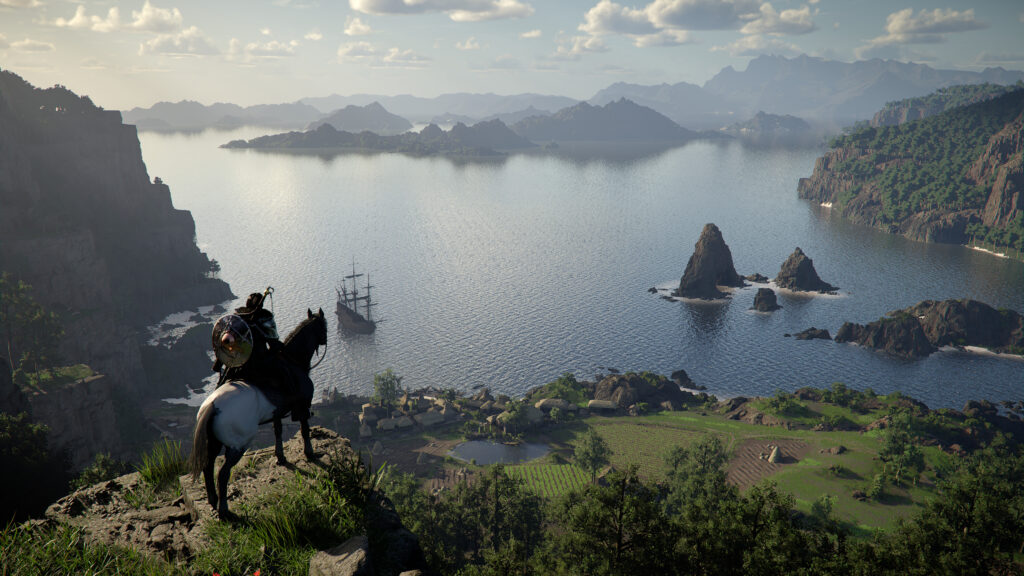
Let’s start where Crimson Desert is at its most impressive: the world itself. The continent of Pywel is an astonishing piece of environmental design — five distinct biomes ranging from mountainous, lush Hernand (where the game begins, despite the title suggesting a desert) through to regions that shift dramatically in atmosphere, culture, and terrain. Pearl Abyss claims the map is twice the size of Skyrim, and having spent more than 70 hours in it, that claim feels credible rather than marketing hyperbole.
“The towns are massive, highly detailed, and distinct from one another. Pearl Abyss has crammed a ridiculous amount of detail into every nook and cranny — the environments feel incredibly lived-in at many points during the journey.”
Five Biomes and a Massive Map
The scale of Pywel creates a genuinely unique problem for a reviewer: it’s almost impossible to claim you’ve seen everything, even after 70 hours. Towns are distinct communities with their own architectural styles, NPC routines, and cultural flavour. The landscapes shift convincingly between regions. Riding on horseback through a new area consistently delivers that specific open-world magic — the horizon revealing something you haven’t seen yet, the sense that meaningful discovery is always within reach.
The downside of this scale is disorientation. Fast travel is heavily restricted, meaning you’ll spend significant time in transit and, if you’re directionally challenged, staring at the map. A world twice the size of Skyrim demands either a stronger waypoint system or a player who genuinely embraces getting lost — and the game doesn’t always give you the tools to make that choice comfortably.
The Abyss — Crimson Desert’s Sky Island Layer
Beyond the ground-level continent, Crimson Desert introduces the Abyss — a secondary exploration layer of floating sky islands that functions as a meaningful gameplay dimension in its own right. Think of it as Crimson Desert’s answer to the Sky Islands in Tears of the Kingdom: vertical platforming challenges, environmental puzzles, and navigational complexity that feels deliberately separate from the grounded world below.
Crucially, the Abyss doesn’t hold your hand. There are no waypoints, no hint systems, and no gentle nudges in the right direction. You solve puzzles through observation and intuition, and navigate the floating landmasses by reading the environment rather than following markers. For players who’ve spent years decrying the hand-holding in modern open-world games, the Abyss will feel genuinely refreshing. For everyone else, it may occasionally tip from challenging into frustrating.
Side Activities: Fishing, Mining, Arm Wrestling and More
If you thought “open world with lots to do” was a sufficient description, Crimson Desert would like a word. The side activity roster includes fishing, wood logging, metal mining, base building, arm wrestling, card games, pickpocketing NPCs, greeting NPCs (every single one can be interacted with), and a knowledge tab that logs discovered locations, factions, and items as you explore. This is sandbox density at its most extreme — and it’s both the game’s greatest strength and one of its clearest weaknesses, which we’ll address shortly.
The Story — Kliff and the Greymanes
A Promising Premise, Poorly Executed
You play as Kliff, a mercenary in a ragtag crew called the Greymanes. Early in the game, the Greymanes are ambushed and decimated by their rivals, the Black Bears. Kliff is killed in the encounter — and then resurrected with mysterious powers connected to a supernatural realm called the Abyss. The rest of the narrative follows Kliff as he rebuilds the Greymanes, forges alliances, and gradually uncovers the deeper mysteries of Pywel’s world.
On paper, this is a perfectly serviceable setup — stranger resurrected with dark powers, a scattered crew to reunite, a continent of political tensions and ancient mysteries. The lore is genuinely well-constructed, the main story bosses are interesting adversaries, and a handful of narrative concepts hint at what the story could have been. The problem is Kliff himself.
Kliff is designed as a brooding, taciturn figure whose actions speak louder than his words. This archetype can work — Joel from The Last of Us, Arthur Morgan from Red Dead Redemption 2 — but only when the quieter moments are filled with genuine emotional weight. Crimson Desert never gives Kliff those moments. He is a passive conduit for events rather than a character driving them. By the time the credits roll, you’ll remember the world far more vividly than the man who walked through it.
Why Character-Driven Stories Matter in Open Worlds
This is worth dwelling on, because it speaks to the game’s deepest structural problem. The greatest open-world games — GTA V, Red Dead Redemption 2, The Witcher 3 — work not merely because their worlds are large and detailed, but because deeply realised characters make us care about what happens in those worlds. Crimson Desert has the world. It doesn’t have the characters. And without that human anchor, no amount of environmental detail can substitute for genuine emotional investment in the story being told.
Combat — Spectacular in Parts, Frustrating in Others
Weapons, Animations and the Good Stuff
The combat is unambiguously Crimson Desert’s second strongest pillar, and at its best it’s genuinely thrilling. The weapon roster — swords, axes, shields, bows, guns, magic, and hand-to-hand — feels meaningfully distinct between classes, and the volume and quality of unique, fluid animations is among the highest I’ve seen in the genre. Cutting through regular enemies with a well-timed combination of abilities is satisfying in a way that kept me engaged even through the game’s more tedious stretches.
9/10
World Design
Five biomes, towns with genuine personality, a seamless open world that consistently impresses
6.5/10
Combat
Spectacular animations and weapon variety undercut by targeting issues and unresponsive dodging
5/10
Story
Solid lore and premise, but a passive protagonist and forgettable supporting cast kill the narrative
9.5/10
Technical Performance
BlackSpace Engine is stunning — 120+ fps at 1440p with DLSS Quality and Frame Gen on RTX 5070
6/10
Game Systems
Fascinating depth on paper, clunky interaction mechanics and menu overload in practice
7/10
Progression
Innovative skill tree and observation system shine, but early resource grind is genuinely tedious
Targeting Problems and Dodge Responsiveness
The combat’s frustrations are specific and persistent. The dodge and evasion mechanics — arguably the most critical tools in any action-heavy game — are not as responsive as the rest of the system demands. In chaotic multi-enemy encounters, you’ll feel that fraction-of-a-second delay at precisely the wrong moments. The auto-target system, which should help in these same chaotic fights, reliably locks onto the least threatening nearby enemy rather than the one actively attacking you. These are not catastrophic failures, but they are consistent irritants that keep combat from reaching the heights its visual spectacle promises.
Boss Fights — Pure Soulslike Pain
The mandatory boss encounters demand a completely different mindset from standard combat. These are Soulslike confrontations in every meaningful sense — requiring pattern memorisation, strategic approach, and mechanical precision. Given the broader combat system’s responsiveness issues, some of these fights will test your patience significantly. But when you crack a boss’s pattern and execute a clean fight, the satisfaction is commensurately high. These are the moments where Crimson Desert’s combat ambition most clearly pays off.
The Observation System — An Underrated Gem
Buried within the character progression is one of the most quietly brilliant mechanics in the game: the observation system. By watching an enemy use a specific ability during combat, you can permanently learn that skill — added to your repertoire without spending skill points. It’s reminiscent of the stance-learning mechanic in Ghost of Tsushima, and it creates an organic incentive to engage with enemies as more than obstacles to be eliminated. This mechanic alone shows Pearl Abyss is capable of genuine design creativity when it breaks free of its MMO habits.
The MMO Problem — When Design Heritage Becomes a Burden
Pearl Abyss built its reputation on Black Desert Online — a massively multiplayer game built around content density, horizontal progression, and an overwhelming amount of things to do at any given moment. That design philosophy is stamped all over Crimson Desert, and while it produces some of the game’s greatest strengths, it’s also responsible for its most significant weaknesses.
Resource Grinding in the Early Game
MMOs gate content behind resource acquisition because they need to fill time across thousands of concurrent players. Applied to a single-player experience, the same logic produces mandatory grind. In Crimson Desert’s early hours, crafting the gear upgrades needed to survive introductory boss fights requires mining resources that are slow to collect and inconsistently located. It’s a genuinely tedious opening tax on a game that otherwise wants to be constantly exciting — and it creates an early impression that the game hasn’t fully considered its single-player audience.
Menu Overload and Inventory Hell
The interface is a genuine problem. Menus stack inside other menus. The inventory fills instantly because quest items remain there until manually sold or discarded — a particularly counterintuitive decision in a game that actively encourages you to pick up every bug, herb, and piece of scrap you encounter. The stash system lacks the clarity and depth needed for a game generating this much item variety. None of these are game-breaking issues individually, but collectively they create a persistent low-level friction that wears you down across a long playthrough.
The Interaction System’s Clunky Mechanics
Interacting with the world’s overwhelming density of objects requires holding a button to aim at specific items, manually rotating the camera to highlight the exact thing you want before the interaction prompt appears. In a world where almost every surface and NPC is interactive, this becomes both time-consuming and occasionally maddening. It’s a system designed for an MMO where deliberate, slow interaction is appropriate — and it hasn’t been meaningfully adapted for the faster pace a single-player game demands.
Technical Performance — A Genuine Engineering Showcase
Whatever Crimson Desert’s structural shortcomings, no honest review can understate how technically impressive it is. Pearl Abyss’s proprietary BlackSpace Engine renders Pywel’s continent with a seamlessness and fidelity that genuinely rivals the industry’s best. The audio design — atmospheric medieval scores drawing heavy Kingdom Come: Deliverance II influences — is excellent throughout, and the English voice acting is solid.
Tested Specs and Real-World Performance Numbers
Review Hardware Configuration
CPUAMD Ryzen 5 7600X
GPUNVIDIA GeForce RTX 5070 (12GB VRAM)
RAM32GB DDR5
Resolution1440p
SettingsEverything maxed, including ray tracing
DLSSQuality + Frame Gen ×3
With DLSS120+ fps average consistently
Without DLSS~60 fps (ray tracing disabled)
DLSS 4.5 and Frame Generation
Crimson Desert’s implementation of DLSS 4.5 and Frame Generation is among the best I’ve encountered in a 2026 release. With DLSS Quality and Frame Gen ×3 enabled, visual fluidity at 1440p is exceptional — the kind of experience that makes the game’s dense environments feel genuinely responsive rather than just visually detailed. In the entire 70+ hour playthrough, only a single hard crash occurred. For a game of this scope and technical ambition, that’s a remarkably stable launch.
Players on mid-range hardware should plan accordingly: Crimson Desert rewards GPU investment. The RTX 5070 is a premium card, and the 60fps floor without DLSS at maximum settings suggests the game will require significant settings adjustments on RTX 3000-series or older AMD hardware to achieve a smooth experience.
Must Check: GTA 6 Cheat Codes (2026) — Complete List for PS5, Xbox Series X|S & In-Game Phone
Crimson Desert vs Red Dead Redemption 2 — The Comparison Everyone Will Make
Given Crimson Desert’s medieval open-world ambitions and explicit visual influences from RDR2, the comparison is inevitable. Here it is, honestly mapped.
| Aspect | Crimson Desert | Red Dead Redemption 2 |
|---|---|---|
| World Scale | Larger — claimed 2× Skyrim | Smaller but exceptionally dense |
| Story Quality | Weak — passive protagonist, forgettable cast | One of gaming’s finest narratives |
| Main Character | Kliff — brooding but underdeveloped | Arthur Morgan — a gaming icon |
| Combat | Action RPG with Soulslike bosses; more complex | Deliberate, weighted gunplay and melee |
| Side Activities | Overwhelming volume — MMO-level density | Curated, story-integrated activities |
| Pacing | Inconsistent — grind periods interrupt momentum | Carefully controlled, consistently engaging |
| Technical Performance | Exceptional — DLSS 4.5, stable, stunning | Well-optimised but older engine generation |
| India Price | ₹4,499 (PC/PS5/Xbox) | Now available at significant discount |
The conclusion is stark: if story is what you’re seeking, Red Dead Redemption 2 remains unchallenged. If you want a technically superior, more mechanically complex, and content-denser open world, Crimson Desert offers something RDR2 doesn’t. They’re ultimately different games wearing similar aesthetic clothes.
Price in India — Is It Worth It?
PC / PS5 / Xbox₹4,499 Standard Edition
MacOS₹4,000 Inexplicably cheaper by ₹499
Sweet Spot (estimate)₹3,000 Valve’s suggested pricing model
The India pricing is worth discussing directly. At ₹4,499 for the standard edition on PC, PS5, and Xbox Series X/S — with a peculiar ₹4,000 price on MacOS — Crimson Desert sits at a premium position. Given the game’s shortcomings in story and early-game pacing, this feels about ₹1,000–₹1,500 higher than the natural sweet spot. Players who are fully bought into the sandbox premise and comfortable with the listed caveats will find the price defensible. Those hoping for a more polished, character-driven experience should wait for a discount.
For context, Valve’s suggested India pricing model would place this game closer to the ₹3,000 mark — which is arguably where the value proposition becomes genuinely compelling rather than merely acceptable.