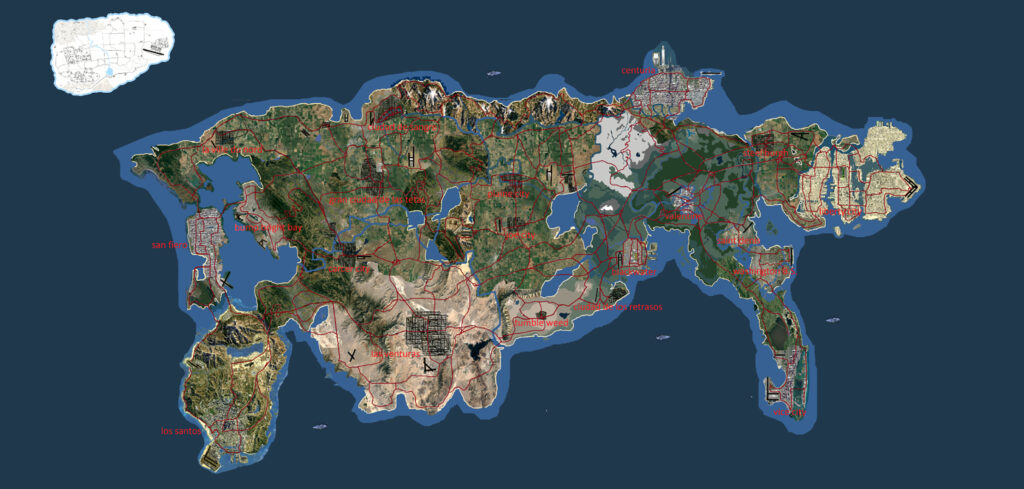
When you have two trailers, a handful of confirmed story details, and no gameplay footage, you do what any self-respecting gaming community does: you build a map. Not the map Rockstar gave you — they’ve been rather selective about that — but a reconstruction built from coordinates, landmark identification, terrain analysis, and the kind of forensic attention to detail that would make a cartographer blush.
That’s exactly what the GTA VI Map Size Comparison Project has done, and the results are genuinely remarkable. This community-built reference site now provides scaled comparisons of GTA VI’s state of Leonida against every major map in GTA history — and the numbers tell a story that should excite almost anyone who has been waiting for this game. They also raise at least one question worth taking seriously.
2.7× Leonida vs Los Santos (est.)
>50% Port Gelhorn vs entire 2002 Vice City
~equal GTA VI Vice City vs GTA V Los Santos
4 Previous GTA Maps Now Compared
What Is the GTA VI Map Size Comparison Project?
Who Built It and How
The GTA VI Map Size Comparison Project is a dedicated community website built by fans who have spent considerable time extracting spatial data from every available official source — trailer footage, ambient audio cues, visible landmarks, horizon lines, and confirmed location names — and assembling them into a coherent, scaled reconstruction of Leonida’s geography.
What makes the project exceptional is what it does beyond just mapping GTA VI in isolation: it now provides to-scale overlays of GTA V’s Los Santos, GTA IV’s Liberty City, GTA San Andreas, and the original 2002 Vice City, all rendered at consistent scale and positioned for direct comparison. The result is a visual that makes the relative size of each game world immediately, viscerally obvious in a way that percentage figures alone never quite convey.
A Reddit post sharing one of the project’s comparison images — with the caption noting that Port Gelhorn alone is more than half the size of the entire 2002 Vice City — sent ripples through the community and quickly accumulated significant traction among fans.
Why Fan Projects Like This Matter
In the almost three years since GTA VI was first announced, Rockstar has released exactly two trailers and a small number of official communications. No gameplay footage. No developer walkthroughs. No interactive map. The information vacuum has been total by design — and it’s created an environment where dedicated community analysis becomes one of the most valuable information sources available to fans.
Projects like the GTA VI Map size comparison initiative fill the space between official marketing beats with genuinely rigorous work. They’re not fabricating information — they’re systematically extracting and organising what already exists in the public record. The mapping project’s scale comparisons are estimates, not confirmed figures, but they’re estimates built on methodical analysis rather than wishful speculation.
“Port Gelhorn is more than half its size” — referring to the entire 2002 Vice City map. That single detail communicates the GTA VI world’s scale more powerfully than any percentage figure.
GTA VI Map Size Comparison vs Every Previous GTA — The Full Comparison
The Numbers in Context
Raw map size comparisons in open-world games can feel abstract without reference points. The GTA VI Mapping Project’s great contribution is making those reference points visual. But for readers who want the numbers alongside the pictures, here is what the current community analysis indicates.
| Game | Map / Setting | Est. Area | Relative Scale |
|---|---|---|---|
| GTA: Vice City (2002) | Vice City | ~5.5 km² | |
| GTA: San Andreas (2004) | State of San Andreas | ~36 km² | |
| GTA IV (2008) | Liberty City | ~16 km² | |
| GTA V (2013) | Los Santos + Blaine County | ~48 km² | |
| GTA VI (2026) — est. | Leonida / Vice City | ~128 km² |
All figures are community estimates based on the GTA VI Mapping Project and prior fan analysis. Official sizes have not been confirmed by Rockstar.
The Most Striking Data Point: Port Gelhorn vs 2002 Vice City
Of all the comparisons the project surfaces, this is the one that stops people mid-scroll. Port Gelhorn — a single named location within GTA VI’s Leonida, believed to be a port town or industrial coastal district — is estimated to exceed half the total playable area of the original 2002 Vice City map.
That isn’t a criticism of the 2002 game; Vice City was built for its era and delivered everything it needed to within its footprint. But it does illustrate, more vividly than any other comparison, just how different the scale of game worlds has become in the intervening two decades. A single neighbourhood-equivalent in GTA VI would have qualified as a substantial chunk of a complete game world twenty years ago.
Vice City in GTA VI vs Los Santos in GTA V
Here is the figure most likely to cause some discussion among fans: the city of Vice City within GTA VI appears, based on the mapping project’s analysis, to cover roughly the same urban footprint as Los Santos in GTA V.
This deserves careful interpretation. It does not mean GTA VI’s Vice City is the same size as GTA V in total — the overall state of Leonida is vastly larger, with the surplus area made up of rural regions, coastal terrain, national parks, and the Keys archipelago. What it does mean is that players expecting GTA VI’s urban environment to be significantly more sprawling than GTA V’s Los Santos may need to recalibrate those expectations.
Whether that matters depends entirely on what Rockstar has done with the density of the city itself. Los Santos is an extraordinarily well-crafted urban environment with remarkable variety packed into its boundaries. A Vice City of comparable footprint but equal or greater density — with the fully enterable interiors Rockstar has confirmed for GTA VI — could feel substantially larger to play through, even if it doesn’t win the square-kilometre comparison.
What We Know About the GTA VI Map’s Confirmed Locations
Vice City
The urban centrepiece of Leonida — a fully reimagined Miami-inspired metropolis rebuilt from the ground up. Neon coastline, dense urban streets, and a social media-saturated modern culture. Roughly equivalent in footprint to GTA V’s Los Santos.
The Leonida Keys
A chain of islands stretching south from the mainland — inspired by the Florida Keys. Likely to offer coastal exploration, water-based missions, and a distinct visual aesthetic from the main city.
Mount Kalaga National Park
A natural park region in the interior of Leonida — providing wilderness terrain, hiking trails, and open country very different from the urban environment. The RDR2-adjacent space most likely to feel either majestic or empty depending on content density.
Port Gelhorn
A port or coastal industrial zone that, per the mapping project, exceeds half the size of the entire 2002 Vice City on its own. Likely a key location for criminal enterprise missions, cargo operations, and large-scale set pieces.
Swampland Regions
Everglades-inspired wetland terrain visible in the GTA VI trailer. Provides a third distinct biome alongside the urban coast and rural inland — murky water, dense vegetation, and the kind of atmosphere that lends itself to very specific mission design.
Suburban & Rural Zones
The connective tissue between Leonida’s major locations — suburban sprawl, small towns, highway corridors, and rural farmland making up much of the map’s total area. The section most dependent on content density to justify its scale.
The RDR2 Parallel — The Legitimate Concern About Big Empty Spaces
What Red Dead Redemption 2 Taught Us About Map Size
Red Dead Redemption 2 is one of the most critically acclaimed games ever made. It is also one of the most sparsely populated open worlds in AAA gaming — deliberately so, as a creative choice that prioritises atmosphere, solitude, and the feeling of genuine wilderness over the constant bombardment of activity markers. For many players, that’s precisely what makes it a masterpiece. For others, it’s the reason they bounced off the game after 15 hours.
The GTA VI Mapping Project’s comparison raises a version of this same question for GTA VI. If the bulk of Leonida’s size advantage over GTA V comes from rural and natural regions — Mount Kalaga, the swamplands, the highway corridors between cities — then the game’s world is only as good as what Rockstar has packed into those regions. Empty countryside in a GTA game feels very different from empty countryside in a Red Dead game, because GTA’s design language is built around density, activity, and the feeling that something interesting is always nearby.
The RDR2 Question Applied to GTA VI
Red Dead Redemption 2’s wilderness worked because the game was deliberately paced for it — slow travel, deliberate encounters, ambient storytelling through the environment itself. GTA VI will be a very different rhythm. Whether Rockstar has designed Leonida’s rural regions to sustain GTA’s faster pace — with random events, dynamic encounters, hidden missions, and organic chaos filling the space — is the central open question the map comparisons raise but cannot answer.
How GTA VI Could Avoid the Same Trap
The good news is that Rockstar has already confirmed several systems designed to make every corner of Leonida feel alive rather than merely large.
- Dynamic NPC behaviour — civilians with daily routines, context-sensitive reactions, and memory of past interactions create organic activity without scripted mission density
- Random world events — GTA V already used these effectively; GTA VI is expected to expand them significantly, seeding the open world with organic opportunities across the map
- More enterable interiors — confirmed by Rockstar, this moves activity off the streets and into buildings, increasing the density of any given area beyond what its footprint suggests
- Lucia and Jason’s movement across Leonida — the story itself is expected to take players through diverse regions of the map, ensuring that rural and coastal areas have narrative purpose rather than being optional exploration zones
None of this is a guarantee that GTA VI’s rural regions will feel as alive as its city streets. But it is evidence that Rockstar is aware of the challenge that comes with building the largest map in the franchise’s history.
Does Map Size Comparison Actually Matter? The Honest Debate
Must Check: GTA 6 New Trailer 3 Release Date: Rockstar’s Cleared Calendar, Key Signals & Everything Confirmed for 2026
The Case FOR Raw Map Size
- More terrain variety means more distinct mission environments and fewer repeated settings
- The Keys, national park, swamps, and city provide genuinely different gameplay atmospheres in one game
- A larger world supports a longer game without feeling repetitive or recycled
- Exploration as pure play is rewarding when the world is built with care
- A large map gives GTA Online years of additional content potential post-launch
The Case for Scepticism
- GTA IV’s smaller Liberty City felt more alive than GTA V’s larger Los Santos to many players
- Rural space is expensive to fill and often underutilised after story completion
- Vice City being only GTA V-sized means the urban player’s experience may not differ as much as expected
- Travel time across a massive map creates friction unless transport options are excellent
- Bigger worlds require bigger teams to maintain — and we’ve already seen two delays
The honest answer is that map size is a means, not an end. GTA IV’s Liberty City — the smallest map in the 3D era — remains many players’ favourite GTA setting because every block felt purposeful and alive. GTA V’s Los Santos succeeded through variety and constant activity. What GTA VI needs is not simply more square kilometres — it needs more of whatever made those previous worlds work, scaled up proportionally to the canvas Rockstar is painting on.
How GTA’s Maps Have Grown Across the Franchise
| Year | Game | Setting Inspiration | Map Era | Notable Design Feature |
|---|---|---|---|---|
| 1997 | GTA 1 | Liberty City, San Andreas, Vice City | Top-down | Three cities in one game, all tiny by modern standards |
| 2001 | GTA III | Liberty City (New York) | 3D era begins | First fully 3D open world — three islands, roughly 8 km² |
| 2002 | GTA: Vice City | Miami, Florida | 3D era | ~5.5 km² — deliberately compact, exceptionally dense |
| 2004 | GTA: San Andreas | Los Angeles, San Francisco, Las Vegas | 3D era peak | Three cities + countryside — ~36 km², franchise’s first rural sprawl |
| 2008 | GTA IV | New York City | HD era begins | Smaller map (~16 km²) but unprecedented urban density and detail |
| 2013 | GTA V | Los Angeles + California | HD era peak | ~48 km² — largest to date; three protagonists; GTA Online lifespan |
| 2026 | GTA VI | Miami / Florida (Leonida) | Next-gen era | Est. ~128 km² — 2.7× GTA V; two protagonists; confirmed more interiors |
The evolution from GTA III’s 8 km² to GTA VI’s estimated 128 km² represents a 16-fold increase in map size across 25 years of the franchise. More significantly, each leap has been accompanied by qualitative leaps in what fills that space — from basic pedestrian scripts to full daily-routine AI systems, from flat facades to confirmed enterable interiors. The trajectory suggests Rockstar understands that size only matters when matched by substance.